
Categories
Home Owner Hub, Home OwnersPublished September 10, 2018
Your Guide to Choosing Kitchen Countertops

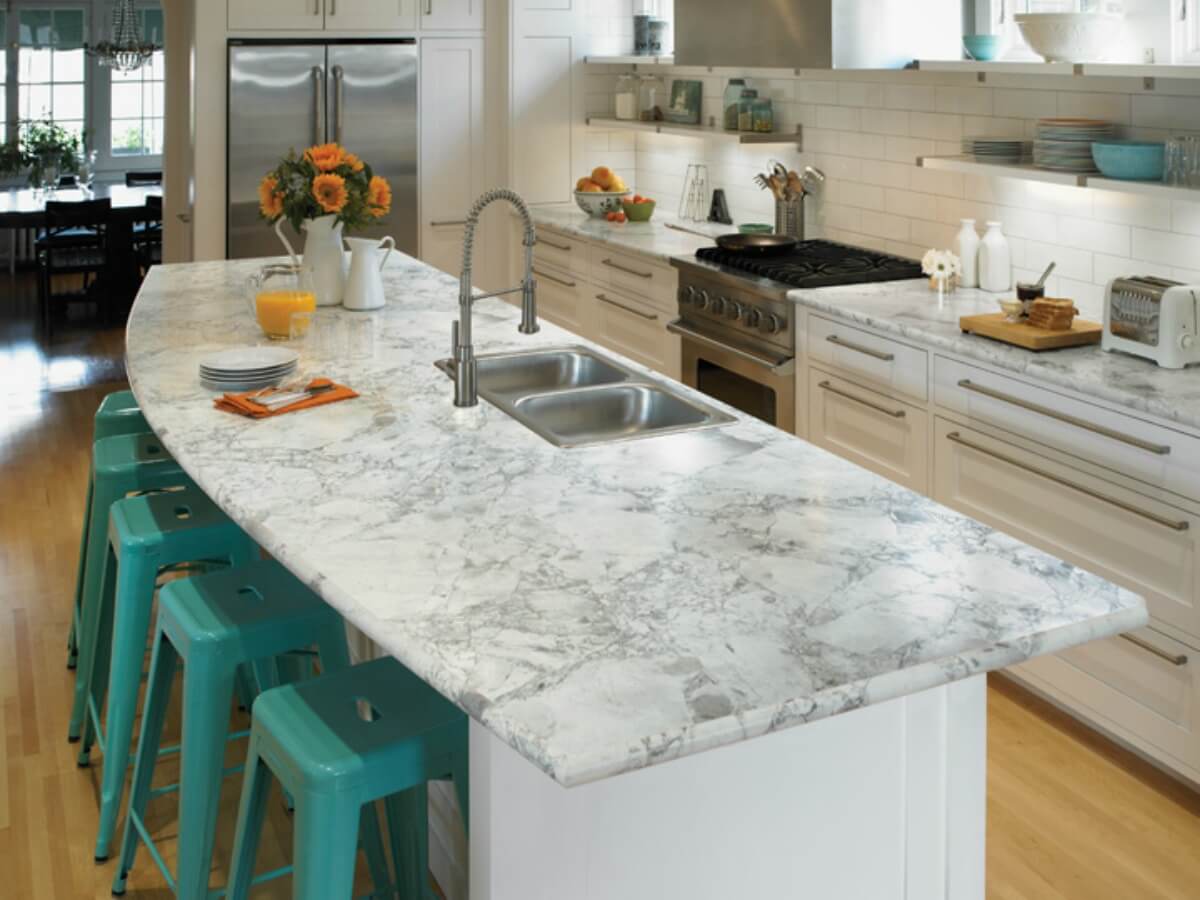
Your Guide to Choosing Kitchen Countertops
Changing your countertops can be a dramatic change for your kitchen and when done right, they may add considerable value to your home.
There are plenty of options out there, from high-end granite and quartz to budget-friendly materials like laminate and tile. No matter what you decide, make sure it fits your needs, personal style and budget.
Things to consider
First, think about how you typically use your kitchen. Are you an avid cook? Home chefs may want to add a butcher’s block section for chopping, while bakers might want to include a marble section for rolling dough.
You’ll also want to consider the overall style you’re aiming for. Ultra-modern kitchens will look sleek with gleaming quartz or stainless-steel countertops; French country pairs well with natural stone, like granite or marble; a Mediterranean aesthetic might work with ceramic tile; and so forth. A bold, coloured countertop may be all the rage, but it may not sit well with future homebuyers.
An increasingly trendy option is installing more than one kind of top in your kitchen. This can help differentiate workspaces and add visual interest while keeping costs down (it’s certainly cheaper to do some of your countertops in quartz instead of all of them). Keep in mind where you are placing your countertops, too – you’re better off with stone sink-hugging counters (rather than wood) to prevent water stains and other considerations.
Materials
Quartz
Quartz has outpaced granite as the go-to high-end material. It’s “engineered stone,” which means it’s created from chunks of stone mixed with resins and colouring.
Pros: Quartz is non-porous, which means it doesn’t have to be re-sealed (unlike granite or wood) and is highly resistant to staining. It’s extremely strong, durable and low maintenance. Because it’s man-made, it has many different colour options and tends to offer more flexibility when it comes to design.
Cons: It’s very expensive, costing 20% to 40% than the second-most expensive option, granite. It also doesn’t have that natural stone look that granite has, so it’s not ideal if you’re opposed to a somewhat manufactured aesthetic. It’s also less heat-resistant than granite, and placing hot pots directly on the surface could cause it to “pop.”
Cost: $$$$$
Granite
Granite is a natural stone, which is polished and sealed for countertop use. It’s an extremely popular choice due to its durability and natural stone look.
Pros: It’s heat, stain, scratch and chemical resistant.
Cons: It’s porous, which means you’ll need to reseal it every few years to prevent stains. Slabs typically come in 10-foot lengths so if you’re looking for a longer run, you may need to add a seam.
Cost: $$$$ – $$$$$
Marble
If classic elegance is what you’re after, then shiny, bright-white marble is a safe bet. Most people choose marble for its looks.
Pros: It’s very glamorous. It’s also great for rolling dough.
Cons: It’s susceptible to stains and scratches, even with sealing. For that reason, it’s not typically used throughout an entire kitchen — most homeowners will limit it to one or two areas.
Cost: $$$$
Quartzite
Quartzite is an up-and-coming surface option often confused with marble. It’s natural stone that’s not quite as hard as granite but offers similar heat, scratch and stain resistance.
Pros: It looks like marble but is much more durable.
Cons: It’s often confused with marble so be sure it’s sourced from a manufacturer who can confirm it’s truly quartzite.
Cost: $$$$-$$$$$
Soapstone
Available in dark charcoal or black, soapstone is visually dramatic and grows richer-looking over time.
Pros: It’s beautiful and eco-friendly.
Cons: It’s softer than other materials. It scratches easily and can be expensive.
Cost: $$$
Solid surface (Corian, Wilsonart)
Solid surface countertops are man-made and touted for their durability, though some experts argue they tend to scratch or crack easily. On the plus side, they’re easily repairable and very affordable. They come in extensive colour and pattern options, including bright colours if you’re looking to stand out.
Pros: They’re inexpensive and more durable than laminate.
Cons: They may scratch or crack and don’t stand up to hot pans as well as other materials.
Cost: $$
Laminate
Laminate is by far your most cost-effective countertop surface option.
Pros: It’s budget-friendly and comes in a wide array of colours and patterns, so it’s highly customizable.
Cons: It’s not at all heat-resistant and scratches easily.
Cost: $
Contact Paper
A budget-friendly way to update old countertops, self-adhesive contact paper comes in endless colours and patterns and can be a great option for renters.
Pros: It’s seriously affordable. You’ll save on installation costs, too.
Cons: It does not withstand heat well.
Cost: $
Concrete
No longer used for just flooring, concrete is edgier than other kitchen materials.
Pros: It’s extremely versatile, durable and can be cast in any shape and multiple colours.
Cons: It’s porous, so it will stain without frequent sealing and is prone to cracking. It’s also extremely heavy, so it will need strong support underneath.
Cost: $$$
Butcher’s block
More and more homeowners are turning to wood to add a warm, rustic feel to their kitchens. When sealed properly, butcher’s block can be both functional and beautiful.
Pros: It’s heat-resistant (unlike laminate) and good for your knives.
Cons: It’s prone to water damage, so steps must be taken to ensure it is sealed properly. It’s also softer than tile, stone and metal and can be damaged more easily.
Cost: $$
Ceramic tiles
Ceramic tiles were once considered the height of luxury in the 1970 and ‘80s. This retro material is now making a comeback thanks to its timeless aesthetic and affordability.
Pros: It’s highly customizable (comes in all styles and colours) and is very resistant to stains and heat.
Cons: It cracks easily and grout can be difficult to clean.
Costs: $$
Bamboo
Bamboo countertops are a green option and great for homeowners who are looking for something a little bit more exotic than your standard wood fare.
Pros: It’s antibacterial and versatile and can be easily sanded and resealed if scratched.
Cons: It’s not at all heat-resistant, so be careful where you place those hot pots. It’s also pricier than some other materials.
Costs: $$$
Recycled Glass
Fairly new to the market, recycled pieces of crushed glass set in acrylic or concrete are an eye-catching option for a more eclectic aesthetic.
Pros: It’s fairly durable and environmentally friendly.
Cons: Not everyone is a fan of this unique look, so it may not be ideal for resale.
Costs: $$ – $$$
Stainless steel
For an industrial or restaurant feel, stainless steel is increasingly popular among home cooks who want that “professional chef” vibe.
Pros: It’s impervious to stains and burns. It’s also a cinch to install, since there’s no sealing process – a sheet of metal is simply cut to size and wrapped over a wood frame.
Cons: One word: fingerprints! It can also be very noisy and has a propensity to dent and scratch.
Costs: $$$
Installation
In addition to the cost of the materials themselves, the price of installing countertops will vary according to the type of edging selected, the number of holes required and the kind of finish or treatment needed (this will depend on the material).
Some countertop materials – like concrete or granite – are so heavy you may have to reinforce the structure beneath the surface. Other countertops, like laminate, are easily installed in an hour or less.
Edging
When it comes to your countertops, it’s all in the details. You’ll want to choose your edging according to material and style. More dramatic or regal edges will only work with quartz, marble or stone, while a straight edge is better for stainless steel or wood tops.
A razor-sharp edge is not only dangerous but also more prone to chipping. Most non-rounded edges, therefore, have a slight kerf or “ease” to them. The degree of ease depends on your aesthetic.
Edges can also be “mitered,” which means assembling an edge from two pieces instead of one. This gives a standard-sized countertop a thicker look without adding extra weight and can allow for more ornate edges.
Edges
The most basic edges are as follows, but they can get more elaborate depending on what you’re looking for.
Squared
Your basic edge, it works with almost all design styles, for a clean, minimalist look – most squared edges have an ease to them, even if very slight.
Bullnose
With rounded tops and bottoms, bullnose edges give a soft touch to your design. They’re ideal for small children because of the rounded edge on the bottom. Other variations include double bullnose, demi bullnose and open bullnose.
Double Bullnose
This version features bullnose edge and a rounded cap that wraps around an outside corner.
Demi Bullnose
This is another bullnose variation that has a rounded top. Unlike the bullnose, it tapers into a sharper edge at the bottom rather than rounding out completely.
Open Bullnose
An open bullnose is a double-stacked edge, which combines a rounded bullnose with another style, like an ogee, stacked on top.
Ogee
For that traditional look, an ogee edge has a concave arch that flows into a convex arch.
Double ogee
A double ogee edge features even more detail and elegance than the classic ogee, with two “S”-shaped curves stacked atop one another.
Roman ogee
A Roman ogee combines the double bullnose’s rounded outside cap with an ogee edge.
Double flat polish
A double flat edge is a square edge (with a slight ease) on all sides.
Half round
Similar to a double flat edge, a half-round edge only differs in its rounded cap that wraps around an outside corner.
Bevelled
Bevelled edges feature a flattened corner at a 45-degree angle and can be finished in a few different styles. A top bevel only has the top corner flattened, while a double bevel flattens both the top and bottom corners.
Replacing your kitchen counters is a big decision and not one you should take lightly. You may want to work with an experienced kitchen designer to select the material, finish and edge that makes the most sense for your taste and lifestyle. Keep in mind there are plenty of other cost-effective ways to give your kitchen a facelift if budget is a concern.
Originally published on Realtor.ca
Stefani Forster https://www.realtor.ca/TrendsInsights/PostPage/5129/1363/Your-Guide-to-Choosing-Kitchen-Countertops/

Assist 2 Sell, HomeWorks Realty
| Assist 2 Sell HomeWorks Realty
or another way