
Categories
Home OwnersPublished March 13, 2018
The Skinny Version of HRM's Centre Plan

The Skinny Version of HRM's Centre Plan
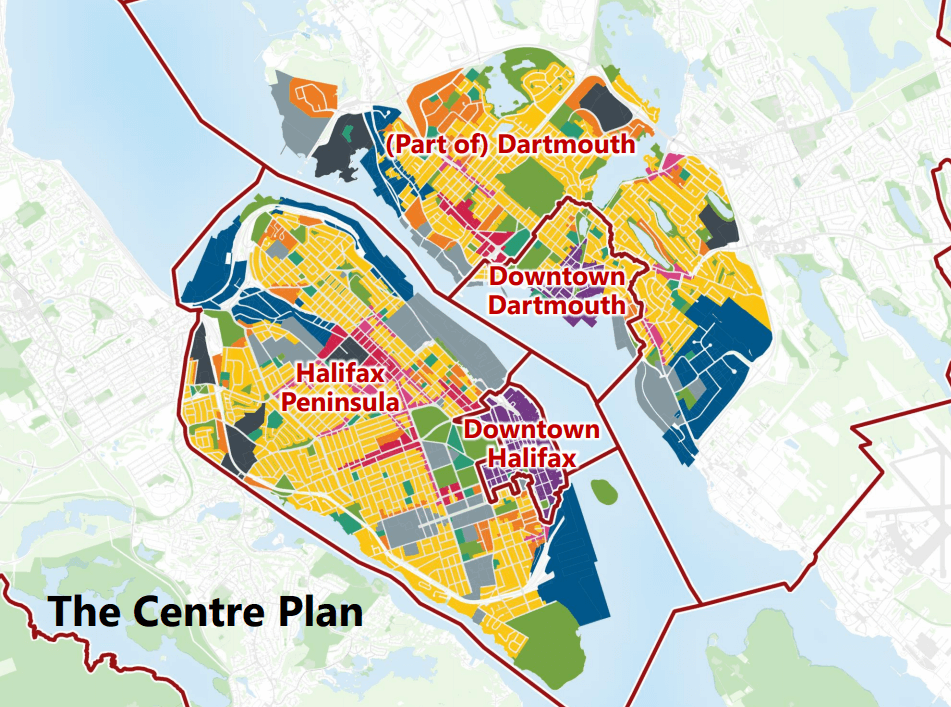
A few weeks ago we had the pleasure of attending a seminar update on the Centre Plan for HRM. Although HRM is only 10.4% of the land area of NS it houses 45.2% of the population of Nova Scotia. The Regional Centre of HRM encompasses .6% of the land area and 24.2 % of the population with 96,619 people and 55,332 Dwellings. The growth of Housing Units in the Regional Center by Permit Increased from just over 600 in 2014 to slightly higher than 1600 in 2017. The need for new fresh guidelines for growth was necessary.
How does this affect you?
If you were hoping to renovate, add a secondary suite inside or love the idea of a backyard granny suite, want a few chickens, or have a small business in your home then you must check out the Centre Plan for HRM. The changes are refreshing and needed.
The 4 Concepts
The Centre Plan is divided into four chapters that state the Goals, Objectives, and Policies that will guide staff in realizing the Core Concepts of the Plan.
The Summary Version of the Plan
Below is a summary of the core ideas of the plan. We have highlighted the ones that are of particular interest to homeowner. Take a peek. You may be suprised how many could potentially affect you.
Consolidate
21 Secondary Municipal Planning strategies that inform 22 Land-use bylaw (some as old at 1950 that contain 481 zones)
Modern Plan & Land Use By-law
• The new documents will be easy to navigate, with web and map ready documents;
• The by-law will include a User Guide aimed at both external and internal users;
• They are written with plain language;
• Illustrations have been added to the LUB to show key concepts;
• A land use matrix shows what can be built where; Updated by-law definitions do not contain regulations;
• Emphasis on “As of-Right” processes to achieve clarity and faster processing times;
• Expansion of Site Plan Approval to achieve better design; and
• One plan and by-law means consistent and clear requirements for all stakeholders in the Regional Centre on what can be built and
where.
Cutting the Red Tape. With fewer Land Use By-law and Policies allows for faster Processing Times focusing on Strategic Growth
• The documents provide clear direction for location and type of future growth;
• Growth areas align with existing or planned infrastructure, transit and active transportation improvements;
• New rules support growth distributed throughout the Regional Centre to support complete communities & 10-minute neighbourhoods;
• Density is directed to existing commercial areas, and close to established residential areas; and
• Required public
Complete Communities
• Zones are generally more permissive to allow for a mix of appropriate uses;
• More compatible uses are allowed as-of-right, simplifying the process;
• Mixed-use buildings are permitted in all growth areas; Complete
• Local commercial uses are permitted in residential areas;
• A greater range of building form is permitted throughout the Regional Centre;
• Secondary suites and backyard units are permitted in low-rise residential areas;
• A mix of unit types are required in multi-unit developments;
• Improved location choices for shared / special care housing options;
• New rules reduce parking standards for multi-unit developments in Centres and Corridors;
• Density bonusing increases the availability of affordable rental housing;
• More options for home occupations and work-live units;
• Potential street grid and active transportation connections are identified for larger sites, to connect new development to existing
communities.
Human Scaled Development
• New rules clearly outline maximum Gross Floor Area Ratio and maximum height provisions;
• Design Guidelines for all Package A zones provide for design flexibility and creativity;
• New rules include transition regulations from mid-rise and high-rise buildings to low-rise buildings;
• Low-rise buildings include a range of single-unit, townhouses, stacked townhouses and other ground oriented units;
• Mid-rise buildings are generally four to six storeys;
• High-rise buildings age no more than 20 storeys;
• Emphasis is placed on the streetwall, in regards to both height and design of the streetwall; and
• Built form regulations focus on access to sun and climate protection;
Pedestrians First
• Active ground floor uses and design is required to encourage interesting streetscapes, with an emphasis on Commercial Pedestrian Streets within Centres;
• Prominent sites are identified to permit additional design creativity;
• New rules require setbacks to allow for wider sidewalks, and space for snow clearing and storage;
• Landscaping requirements are included to encourage a pleasant public realm and provide screening from less pedestrian-oriented
uses; and
• Density bonusing options include publicly accessible open space, public art and restoration of registered heritage buildings.
Culture & Heritage
• Density bonusing is not permitted where demolition of a registered heritage building is proposed;
• Density bonusing is available where a restoration of heritage buildings is proposed;
• New regulations include flexibility for registered heritage properties and identified landscape buildings to encourage adaptive re-use;
• Future Heritage Conservation Districts and Cultural Landscapes are identified;
• Continued protection of view corridors to the Halifax Harbour and other water bodies;
• Continued protection of view planes and ramparts from Halifax and Dartmouth;
• Design guidelines for development that is adjacent to a registered heritage building is extended to all Package A zones;
• Affordable community/cultural space and public art are possible public benefits that can be provided through the density bonusing
program;
• Permissions regarding home occupations and live/work expand the opportunities for artists and galleries; and
• Planning documents bring forward policy support for pop-up projects in public open spaces;
Sustainability
• New landscaping requirements include:• incentives to keep existing landscaping during a development • species diversity requirements
• requirements for soft landscaping, to help with stormwater Management
• green roofs included in landscaping requirements
• enhanced design and landscaping requirements for parking Lots
• Minimum motor vehicle parking requirements are significantly reduced, where required
• Newly permitted urban agriculture uses including chickens (hens only) and bees (one hive for most properties)
• Electric vehicle charging station requirements are included;
• Stormwater management is required for larger sites;
• Greenhouses and solar panels are permitted to exceed height restrictions;
• Water lot protection is maintained on the Northwest Arm, and expanded to Lake Banook;
• District Energy is encouraged in Future Growth Nodes;
• New rules include bird-friendly design requirements.
Mobility
• Growth is focused strategically in areas with current and proposed high frequency transit;
• Policies encourage and require traditional street-grid connections on larger sites;
• Bicycle parking requirements have been refined, including the provision of showers and lockers for bike commuters who work at
office buildings, banks, hospitals, etc.
• Off-street loading space for residential and commercial uses above a certain threshold is required, to minimize deliveries blocking traffic
lanes
• Setbacks are required on main streets to allow enough space for pedestrians and proper snow clearing and storage
• New building design is focused on the human-scale, promoting more interesting streetscapes which encourages more walking.
Health
• More mixed-use zones, including requirements for ground-floor retail, promote walkable neighbourhoods;
• Ground-related units, and permitted encroachments like porches, ramps and steps, are included to encourage accessibility and “eyes
on the street”;
• More opportunities for urban agriculture, production, and retail of food, including farmers markets;
• Strategic growth supports infrastructure investments in transit and active transportation which encourages more active ways of
commuting;
• Human scale design emphasizes pedestrian and social interaction – improving mental well-being;
• Increased landscaping improves the environment we live in
• Setbacks from railways and main arterials encourage support healthy and safe residential environments.
Business / Economic Development
• A user-friendly use table that makes it easy to figure out where any kind of business or activity is permitted;
• Undersized lots can be redeveloped for any permitted use, if built form requirements are met;
• Pre-existing (non-conforming) uses and buildings can continue to exist and are legally protected;
• Approved development agreements will continue to have legal status;
• Minimum motor vehicle parking requirements are significantly reduced;
• New permissions exist for emerging kinds of employment: home occupations, home offices, work-live units, local commercial,
fabrication (i.e., maker-spaces), business incubators;
• New regulations bring greater opportunity for local commercial uses in residential areas;
• Requirements for smaller storefronts create opportunities for smaller businesses;
• The new documents bring streamlined approval processes;
• New documents contain policy support for new programs that link empty storefronts for pop-up businesses;
• Many larger businesses look for communities with active transportation infrastructure, lively streets, good transit, and local
commercial when looking to expand) – the Centre Plan sets the ground work for this kind of community
• New documents support local commercial uses in parks;
There are many upcoming Public Open Houses so that you can have your input into the direction of the Centre Plan.
*Statistics Canada

Assist 2 Sell, HomeWorks Realty
| Assist 2 Sell HomeWorks Realty
or another way